The Number Your Skin Has Been Waiting For: Understanding pH and Why It Transforms Your Soap Routine

You probably haven't thought much about chemistry since high school. But here's the thing — your skin is thinking about it every single day. The moment you lather up and rinse off, a quiet little battle is playing out on your skin's surface, and pH is right in the middle of it.
Most people chalk up dry, tight, or irritated skin after washing to hard water, cold weather, or just having "sensitive skin." And sure, those things matter. But more often than not, the real culprit is a mismatch between the product you're using and the natural chemistry of your skin. Once you understand that, the whole way you shop for soap changes.
What pH Actually Means (No Lab Coat Required)
pH is a scale from 0 to 14 that measures how acidic or alkaline a substance is. Pure water sits right in the middle at 7 — perfectly neutral. Anything below 7 is acidic, anything above is alkaline (sometimes called basic). Lemon juice is around 2. Baking soda is around 9. Battery acid is near 0. Bleach is near 13. You get the picture.
Your skin's natural surface — called the acid mantle — sits somewhere between 4.5 and 5.5. That slightly acidic environment isn't an accident. It's a finely tuned protective layer that keeps harmful bacteria out, locks moisture in, and supports the microbiome of good organisms living on your skin. Disrupt that layer and you open the door to dryness, breakouts, sensitivity, and irritation.
Here's where soap enters the conversation.
Why Traditional Soap Has a pH Problem — And Why It Doesn't Have To
True soap — the real stuff, made by combining oils or fats with an alkali like lye — is naturally alkaline. The saponification process that creates soap pushes the pH up to somewhere between 9 and 10. That's a significant gap from your skin's preferred 4.5 to 5.5 range.
For a lot of people, that gap is exactly why washing with certain soaps leaves their face feeling like a dried-out rubber band. The alkalinity temporarily disrupts the acid mantle, stripping away protective oils and throwing the skin's microbiome off balance. Your skin works hard to recover — usually within a few hours — but if you're washing multiple times a day with a high-pH product, it never quite gets the chance.
Now, here's the twist most people don't know: not all soaps are created equal, and the way a handmade soap is formulated can make a real difference in how your skin responds.
The Detergent Bar Deception
Walk into any drugstore and you'll find shelves packed with products labeled as "beauty bars," "cleansing bars," or "moisturizing bars." Very few of them are actually soap in the traditional sense. Most are synthetic detergent bars — sometimes called syndets — formulated with surfactants derived from petroleum or other industrial processes.
Detergent bars can be engineered to hit a lower, skin-friendlier pH. Sounds like a win, right? But the trade-off is a long ingredient list packed with preservatives, synthetic fragrances, stabilizers, and fillers. The lower pH doesn't come from a natural formulation — it comes from chemical manipulation. And while those bars might not disrupt your acid mantle as aggressively, they introduce a whole different set of concerns for people trying to keep things clean and simple.
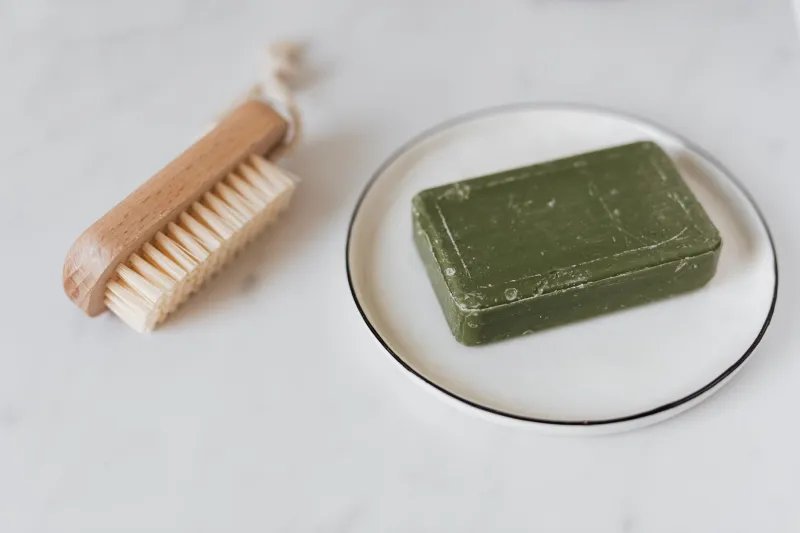
True handmade soap, on the other hand, uses real oils, butters, and botanicals. The pH is higher by nature — but a skilled soap maker can work with that reality in smart ways.
How Handmade Soap Makers Work With pH
Experienced artisan soap makers know that the oils they choose directly influence the final bar's behavior on skin. Certain oils — like castor oil, avocado oil, and shea butter — contribute to a creamier, more conditioning lather that feels gentler even at a higher pH. Superfating, a technique where a small percentage of oils are left unsaponified (meaning they weren't fully converted during the soap-making process), leaves a thin layer of nourishing oil in the finished bar. That residual oil helps buffer the alkalinity and leaves skin feeling softer after rinsing.
Some makers also use a technique called water discounting or adjust their lye calculations carefully to create a harder, longer-lasting bar that cures well and behaves more gently. The curing process itself — where a fresh bar of soap rests for four to six weeks — allows the pH to naturally mellow and the bar to become milder over time.
None of this happens in a mass-production facility cranking out millions of bars. It happens at the small-batch level, where the maker actually has time to think about what goes into each formula.
The Myth That All Soap Is Harsh
There's a persistent idea floating around wellness circles that soap — any soap — is inherently bad for your face and should be avoided in favor of gel cleansers or micellar water. For some skin types, that advice genuinely holds. But writing off all soap as harsh is an oversimplification that ignores the nuance of formulation.
A well-crafted bar made with high-oleic oils like olive or sweet almond, superfatted at around 5 to 8 percent, and fully cured can be remarkably gentle. Plenty of people with dry or sensitive skin have found that switching to a quality handmade bar actually improved their skin over time — less tightness, fewer flare-ups, and a more balanced feel throughout the day.
The key is knowing what you're buying and understanding that "soap" is not a monolith.
What This Means When You're Shopping
When you're browsing for a new bar, a few questions are worth asking. Does the maker list their oils? Do they mention their superfat percentage? Have they shared anything about their curing process? These details aren't just marketing fluff — they're genuine indicators of how a bar was made and how it's likely to perform.
At Alada Soap, every bar we craft starts with ingredients chosen for a reason. The oils aren't random — they're selected based on how they behave during saponification, how they contribute to lather and conditioning, and how they leave skin feeling after the rinse. We're not chasing a magic pH number, but we are paying close attention to the formulation decisions that make a bar genuinely good for your skin.
The Bigger Picture
pH isn't a buzzword. It's a real, measurable factor that shapes how your skin responds to everything it touches. Understanding it doesn't mean you need to carry a pH meter into the shower — it just means being a little more thoughtful about what you're reaching for.
Your skin is already doing a lot of work to keep itself balanced and healthy. The least you can do is give it a soap that doesn't work against that effort.