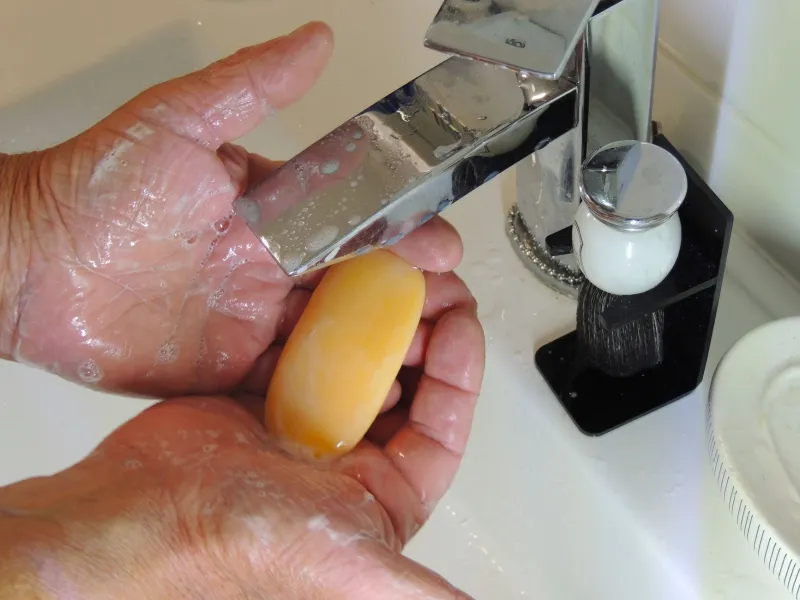
Meet Your Skin's Invisible Allies — And Why Your Soap Might Be Fighting Them
Photo: TracesPalestine, CC BY 4.0, via Wikimedia Commons
You wash your hands, hop in the shower, lather up, rinse off. Simple enough, right? But underneath that everyday ritual, something a lot more complex is happening — and depending on what's in your soap, you might be doing your skin a favor or quietly working against it.
The truth is, your skin isn't just a surface. It's a living ecosystem.
Your Skin Is Basically a Tiny Universe
Scientists call it the skin microbiome — the enormous, diverse community of bacteria, fungi, and other microorganisms that live on and in your skin. Before you reach for the hand sanitizer, hear this out: most of these tiny residents are not just harmless. They're genuinely helpful.
Organisms like Staphylococcus epidermidis and various Lactobacillus strains help regulate inflammation, crowd out harmful pathogens, and even communicate with your immune system. Think of them as a neighborhood watch — always present, always working, keeping things calm and balanced. When that community is healthy and diverse, your skin tends to look and feel better. When it's disrupted, you can end up with dryness, irritation, breakouts, or worse.
Research into the skin microbiome has exploded over the last decade, and dermatologists are increasingly connecting microbiome imbalances to conditions like eczema, rosacea, acne, and chronic sensitivity. The takeaway? What you put on your skin every day — including your soap — has a real, measurable effect on this invisible ecosystem.
What Commercial Soaps Are Actually Doing
Here's where it gets a little uncomfortable. A lot of conventional soaps and body washes sold in American drugstores and big-box stores are formulated with ingredients that don't exactly play nice with your skin's natural community.
Sodium lauryl sulfate (SLS) and sodium laureth sulfate (SLES) are the heavy-hitting surfactants responsible for that satisfying, foamy lather. They're effective at removing dirt and oil — extremely effective, actually. So effective that they strip away not just grime but also the natural lipids your skin uses to maintain its protective barrier. Without that barrier intact, moisture escapes more easily and irritants get in more readily. And your microbiome? It loses the stable, slightly acidic environment it needs to function.
Then there are antibacterial soaps. Triclosan was the big name for years — added to soaps, toothpastes, and cleaning products with the promise of killing germs. The FDA eventually banned it from consumer soaps in 2016 after evidence suggested it was no more effective than regular soap and potentially harmful. But the broader category of antibacterial agents hasn't disappeared. Benzalkonium chloride and other alternatives are still around, and they share the same fundamental problem: they don't discriminate. They go after the bad actors and the beneficial bacteria alike, leaving your skin's ecosystem less diverse and more vulnerable.
Fragrance is another issue. Synthetic fragrance compounds — often listed simply as "fragrance" on an ingredient label — are among the most common causes of contact dermatitis in the US. They can disrupt the skin's surface environment in ways that make life harder for beneficial microbes.
The Case for Simpler Formulas
So what does a soap look like when it's actually working with your skin rather than against it?
Handcrafted soaps made with natural oils and botanical ingredients tend to have much shorter, cleaner ingredient lists. That simplicity isn't just a marketing angle — it has real implications for how your skin responds.
Oils like olive, coconut, castor, and shea butter contain fatty acids that closely mimic the natural lipids already present in your skin. When a soap is made with these ingredients through the traditional cold-process method, it retains glycerin — a naturally occurring byproduct of saponification that draws moisture to the skin. Most commercial manufacturers actually remove glycerin from their soap and sell it separately for use in lotions. You're left with a cleaner-looking bar that does a lot less for your skin.
Botanical extracts — things like calendula, chamomile, and oat — bring their own gentle, skin-supportive properties. They don't bulldoze your microbiome. They're more like a light touch than a power wash.
The pH factor matters here too. Healthy skin sits at a slightly acidic pH, somewhere around 4.5 to 5.5. That acidity is part of what makes it a hospitable environment for beneficial bacteria and a hostile one for pathogens. Many commercial soaps are significantly more alkaline, which can temporarily shift your skin's pH in ways that stress the microbiome. Well-formulated handmade soaps tend to land at a more skin-compatible pH, especially when they're made with quality fats and allowed to cure properly.
Less Really Is More
The "more ingredients = more benefits" logic that drives a lot of commercial skincare marketing doesn't really hold up when you look at the science. For your skin's microbiome, stability and consistency matter more than novelty. A soap that shows up every day without stripping, shocking, or chemically overwhelming your skin is doing more for you in the long run than one loaded with actives and preservatives.
At Alada Soap, the minimalist philosophy isn't about cutting corners — it's about respecting what's already there. When you keep the formula clean and the ingredients recognizable, you're giving your skin's ecosystem room to do what it was designed to do.
Small Choices, Real Consequences
You probably don't think about your microbiome while you're in the shower. Nobody does. But the choices you make in that two-minute window add up over weeks and months. Switching to a handcrafted bar made with nourishing oils and none of the usual chemical disruptors isn't a dramatic lifestyle overhaul — it's a small, sustainable shift that your skin can genuinely feel.
Your invisible allies are working hard for you around the clock. The least you can do is give them a soap they can live with.